iPhone 16 Pro Max repairs: screens, batteries and other common faults
A cracked iPhone 16 Pro Max screen is difficult to ignore, especially when you use that large display for reading, maps or work. Before agreeing to a repair, check whether the damage is limited to the front. A fall can also affect the frame, side controls or cameras, even when the phone still turns on normally.
Check your model: A3296 (common UK/international model; regional variants exist). If you can, check the name and code in Settings before ordering parts.
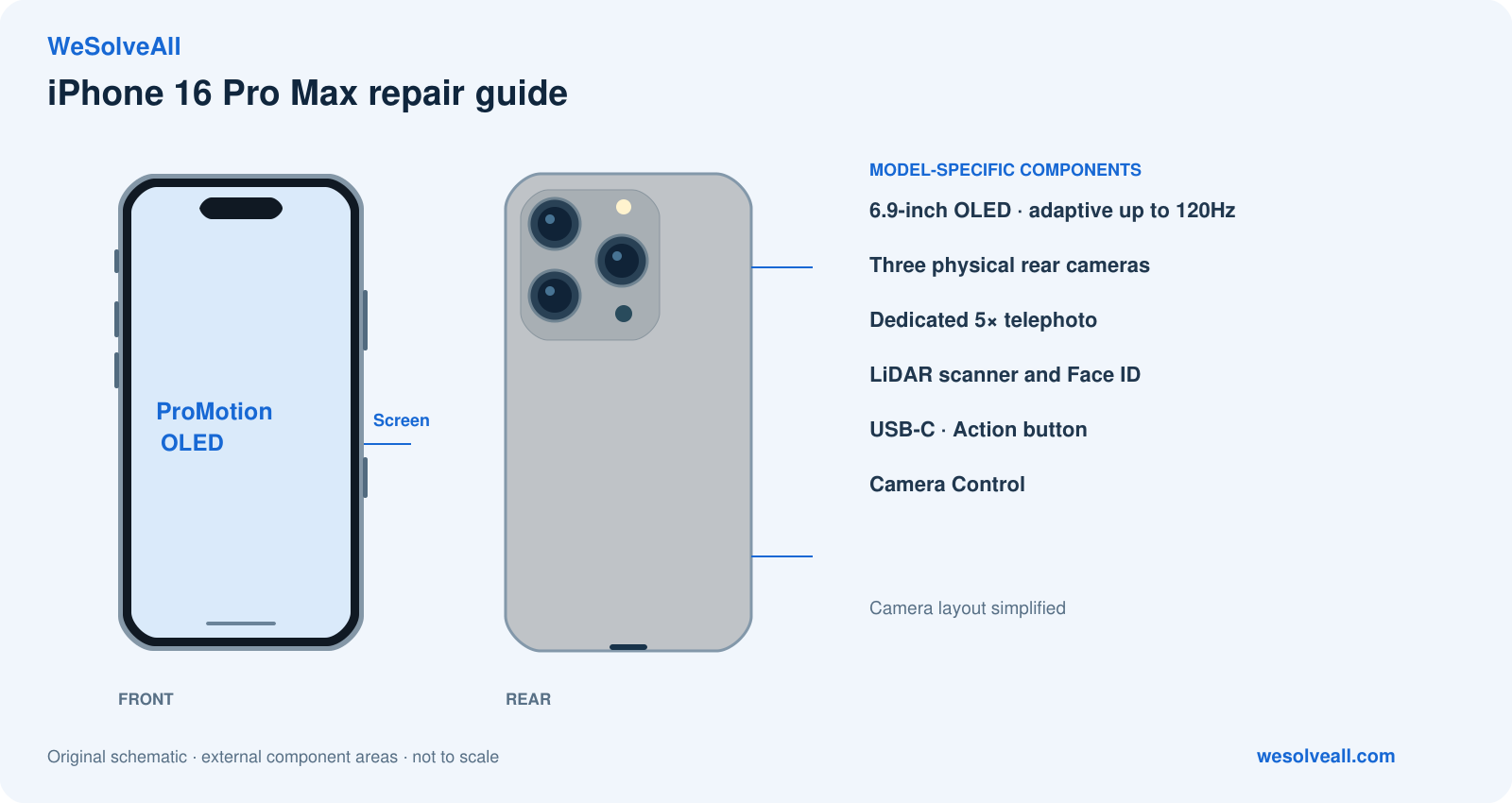
Which replacement screen should you choose?
The 16 Pro Max uses a 6.9-inch ProMotion OLED panel. The exact model matters more than the size: another 6.9-inch screen isn't automatically compatible. Ask which original display features the proposed replacement supports, including adaptive refresh and Always-On functionality.
These are the part descriptions you may come across. The shop needs to confirm what it can supply for your exact phone; every option won't be available from every repairer.
| Screen option | What you are paying for |
|---|---|
| New genuine Apple OLED | A new manufacturer-origin screen, if the shop can source one. Ask it to identify the part, confirm that it is new and include fitting, testing and any required repair-completion work in the price. |
| Used original OLED | An original screen taken from another handset. It is still a used part, so ask about scratches, wear, testing and its suitability for reuse on your phone. |
| Refurbished original OLED | An original panel with specified damaged parts renewed, often the outer glass. Ask what remains original, what has been replaced and who guarantees the finished screen. It isn't the same as a completely new manufacturer-supplied assembly. |
| Aftermarket soft OLED | A compatible OLED made by another manufacturer, using a flexible panel base. Ask for the actual part specification: the word soft doesn't tell you its brightness, touch quality or which original display features it preserves. |
| Aftermarket hard OLED | A compatible OLED using a rigid panel base, where a tested option exists for this model. Check its fit, display behaviour and warranty. The shop should explain any differences you would notice in use. |
| Budget LCD / in-cell conversion | An LCD alternative, only if the repairer has a tested option for this exact model. It changes the original OLED technology. Ask about picture quality, fit, power use and any lost display features before choosing it. |
| Glass-only refurbishment | A specialist replaces the broken outer glass while keeping a suitable working panel. The picture, touch layers and frame need checking first. It won't cure damage inside the display. |
A large display needs a frame that fits it
If a corner has bent or a gap has opened around the screen, show the repairer before it quotes for a display alone. The frame and mounting points need checking so the new screen can sit correctly. Pressing a damaged housing together isn't a repair.
When comparing parts, ask what you would see in normal use: touch at the edges, brightness, colour and scrolling behaviour. Original, refurbished original and aftermarket are useful descriptions only when the shop explains the actual assembly.
Check the side control after an impact
Camera Control sits on the side of the phone, where an impact can damage the control or its surrounding enclosure. Say whether the camera still works using the screen, and whether the side control is stuck, cracked or completely unresponsive.
The 5× telephoto, main and ultra-wide cameras need their own tests. A failure in one view doesn't mean every camera has failed, and broken lens-cover glass is a separate part from the camera underneath.
A combined repair still needs separate answers
If the screen is broken and the battery has been fading for months, ask for individual prices as well as a combined quote. That lets you decide whether both jobs make sense. A larger phone's battery can still wear with use, but poor charging and short runtime need distinguishing first.
Call sound is worth describing carefully too. Quiet audio at your ear, poor speakerphone sound and recordings that others can't hear can involve different speakers, microphones or circuits.
What else can be repaired on your iPhone 16 Pro Max?
You don't need to know the name of a faulty part before contacting a shop. The list below covers the repair and diagnostic areas for this model. Open a section to find the problem you recognise. Some parts share an assembly, so several symptoms may lead to one repair rather than several separate charges.
Screen and touch
- Display assembly
- Cracks, dark patches, lines or touch problems can call for a replacement screen assembly. The shop should check the display, frame and connections, then explain which of the screen choices above suits the damage.
- Front glass refurbishment
- If the picture and touch still work, a specialist may be able to keep the original panel and replace its outer glass. The display and frame have to be suitable; cracks alone don't settle that decision.
- Display connectors and circuit
- A connection or circuit fault can cause a missing image or unreliable touch. The repairer may need to repair the connector or original board. This OLED phone doesn't have a separate LCD-style backlight.
Battery and charging
- Battery and battery connector
- Shorter runtime, unexpected shutdowns or swelling are reasons to have the battery checked. If it needs replacing, ask whether the new battery is genuine or compatible, its stated capacity and warranty, and what battery information the phone should show afterwards. Stop charging a swollen phone.
- USB-C charging socket
- A cable that won't seat properly, interrupted charging or a failed computer connection can involve the USB-C socket. Ask the shop to check the cable and opening before deciding whether cleaning, connector work or a replacement assembly is needed.
- Wired charging and USB data diagnosis
- Tell the shop if charging is slow, the connection drops or a computer no longer recognises the phone. Testing a compatible lead and charger helps separate an accessory problem from socket or circuit damage.
- Wireless charging assembly
- If wireless charging fails while cable charging works, mention that. The shop can check a suitable charger and case first, then the coil, connections and charging circuit. A broken back may need checking at the same time.
Cameras and Face ID
- 48MP main / Fusion camera
- A camera that shakes, won't focus or shows a black picture needs testing in the affected view. The shop can check the module and its connections, then name the actual camera or combined assembly in the quote. The 2× option uses this main sensor; it isn't another camera module.
- 48MP ultra-wide camera
- A camera that shakes, won't focus or shows a black picture needs testing in the affected view. The shop can check the module and its connections, then name the actual camera or combined assembly in the quote.
- 12MP 5× telephoto camera
- A camera that shakes, won't focus or shows a black picture needs testing in the affected view. The shop can check the module and its connections, then name the actual camera or combined assembly in the quote.
- LiDAR scanner and connections
- Depth-related camera problems may involve the LiDAR scanner, its connection or nearby hardware. The repairer needs to identify the cause; one depth symptom doesn't prove that the scanner itself has failed.
- External camera lens cover / surround
- Broken protective glass and a faulty camera are different repairs. The shop can inspect the lens cover, surround and camera beneath it before deciding whether new cover glass is enough.
- Front / selfie camera
- A blurry, black or unreliable selfie image needs the front camera and its connection checked. On this iPhone, the shop should also explain any implications for the adjacent Face ID system.
- Face ID
- If Face ID has stopped recognising you, ask for the original TrueDepth parts and connections to be checked. Some faults need specialist work. A generic camera swap isn't a guaranteed way to restore it.
- Flash and rear recording audio
- A failed torch, flash or poor audio while filming can involve different parts. Tell the shop exactly which functions fail so it can check settings, temperature restrictions, the microphone and the relevant connections.
Sound, calls and microphones
- Top / earpiece speaker
- Quiet or distorted sound at your ear can come from a blocked grille, speaker or connection fault. The shop can clean or replace the affected part, taking care around any adjoining front sensors.
- Bottom loudspeaker
- Missing or distorted ringtones, music or speakerphone audio can involve the bottom speaker. Its outlet and connections need checking before a replacement is chosen; persistent faults may need audio-circuit work.
- Microphones and audio paths
- Tell the repairer whether people can't hear you on calls, voice recordings sound poor or video audio is affected. Different modes can use different microphones, so the openings, relevant assembly and audio connections need testing.
Buttons, vibration and sensors
- Side / power and volume buttons
- Sticking controls, a missing click or an unreliable response can involve the external button, its mechanism or an internal cable. Describe which control fails and let the shop check settings and damage before selecting a part.
- Action button
- Check the assigned action first. A button doing the wrong thing is different from a stuck or damaged control. The shop can then check the button, its mechanism and internal connection.
- Camera Control
- If the side camera control sticks or stops responding, say whether the camera still works from the screen. Settings, the physical control, its connection and damage to the enclosure need different checks.
- Taptic Engine
- If vibration has become weak, noisy or stopped altogether, check the settings first. The repairer can then check the vibration unit and its connection and replace the correct part if needed.
- Proximity and ambient light sensing
- A screen that stays on against your cheek or brightness that changes oddly can involve the front sensors or their path through the screen. Mention if the problem began after screen work so fit and connections can be checked.
Signal, SIM and other connections
- SIM tray and physical reader, where fitted
- A damaged tray, stuck card or SIM detection problem needs the SIM and regional hardware checked. Some imported versions use different arrangements; an eSIM-only phone has no physical tray to replace.
- Mobile antennas and signal connections
- Poor reception needs coverage, account and SIM problems ruled out first. If hardware is responsible, the shop can check antennas and connectors, with specialist modem or board work where necessary.
- Wi-Fi, Bluetooth, GPS and NFC
- Explain which connections fail and whether the problem happens with more than one network or accessory. Software and settings checks come first, followed by the relevant antennas, connectors or board circuitry if needed.
- Other fitted sensors
- Location, contactless, motion or other sensor problems need their own checks. The shop can separate settings and software issues from damaged antennas or circuitry. These functions aren't all separate plug-in parts.
Back glass, frame and seals
- Back cover / back glass
- Cracked rear glass needs checking for damage underneath. Ask whether the quote covers glass or a complete rear assembly, and have the frame, camera area and wireless charging checked where relevant.
- Frame / enclosure
- Bent corners, gaps and parts that no longer sit correctly can need a replacement housing or frame. Ask which model, colour and assembly the quote covers, and which working parts will be transferred.
- Adhesives, seals and thermal materials
- Opening the phone usually means renewing the adhesives and other materials required by the repair. Ask how it will be resealed and tested. Fresh seals alone don't guarantee the original factory water-resistance rating.
Internal connections and specialist work
- Cables, brackets, shields and fixings
- A damaged cable, connector, bracket or mounting can stop an otherwise working part doing its job. The repairer should identify the broken connection or fixing and quote for that work.
- Motherboard / logic board
- A confirmed circuit fault may need specialist work on the original board or a properly specified replacement. Ask about the difference in price, pairing and data consequences before choosing; another board won't bring back the files on the original one.
- Liquid damage assessment
- Tell the shop what happened and whether the phone was charged afterwards. Inspection and suitable cleaning can establish which parts are affected, but recovery and long-term reliability depend on the damage. Stop charging a wet phone.
- No power, restarting and overheating
- A phone that won't start, keeps restarting or shuts down needs the cause checked. Battery, software, internal connections and board faults can produce similar symptoms, so booking a guessed replacement part can waste money.
Software, backup and data
- Software, backup and data recovery
- Say whether you want normal operation restored, files recovered or help with a backup or transfer. Agree before any reset that could erase data. Recovery depends on the original hardware, damage, encryption and access credentials.
Parts, price and the small print worth reading
For a battery, ask whether the replacement is new genuine or a traceable compatible part, with its capacity and warranty stated. Reusing an original battery control board doesn't make a compatible replacement cell wholly genuine. Cameras, charging assemblies and cosmetic parts need the same clear description of origin, condition and compatibility.
Get the total fitted price, including VAT where applicable, any diagnostic charge and the likely collection time. Agree how the shop will contact you if it finds more damage. If your photos or documents are the priority, say so before a reset or board replacement is discussed.
iPhone 16 Pro Max repair questions
Will any 6.9-inch Pro Max screen fit the 16 Pro Max?
No. The repair needs an exact 16 Pro Max-compatible display. Matching screen measurements don't establish compatibility.
Can I ask for a screen and battery quote together?
Yes. Ask for both individual prices and the total, with each part and warranty clearly named. That helps you decide which work you want done.
How much will the repair cost?
The shop needs to know the fault, exact model and proposed part. Ask for the total fitted price and compare the part description, testing and warranty alongside it. Prices and appointment availability come from the selected repairer.
Will the phone be water-resistant afterwards?
Ask how the shop will replace seals and what it can test. Fresh adhesive doesn't, by itself, guarantee the original factory water-resistance rating. Keep a phone with broken glass or openings away from water.
What should I check when I collect it?
Try the repaired function and anything affected by the work: touch, cameras, charging, call sound and the phone's supported unlocking method. Ask the repairer to explain any parts message or feature limitation before you leave.
Find an iPhone 16 Pro Max repair shop
Use WeSolveAll to find a shop for your 16 Pro Max, then agree the damage being repaired and the parts being fitted. A clear estimate should also explain testing, warranty and what happens if more damage is found.
Find a repair shop