iPhone 13 repairs: screens, batteries and other common faults
You can get used to working around a damaged phone: tapping beside a crack, carrying a power bank or taking every call on loudspeaker. Those small workarounds soon become tiresome. If your iPhone 13 otherwise does the job, a repair quote can help you decide whether it's worth putting things right.
Check your model: A2633 (common UK/international model; other regional codes exist). If you can, check the name and code in Settings before ordering parts.
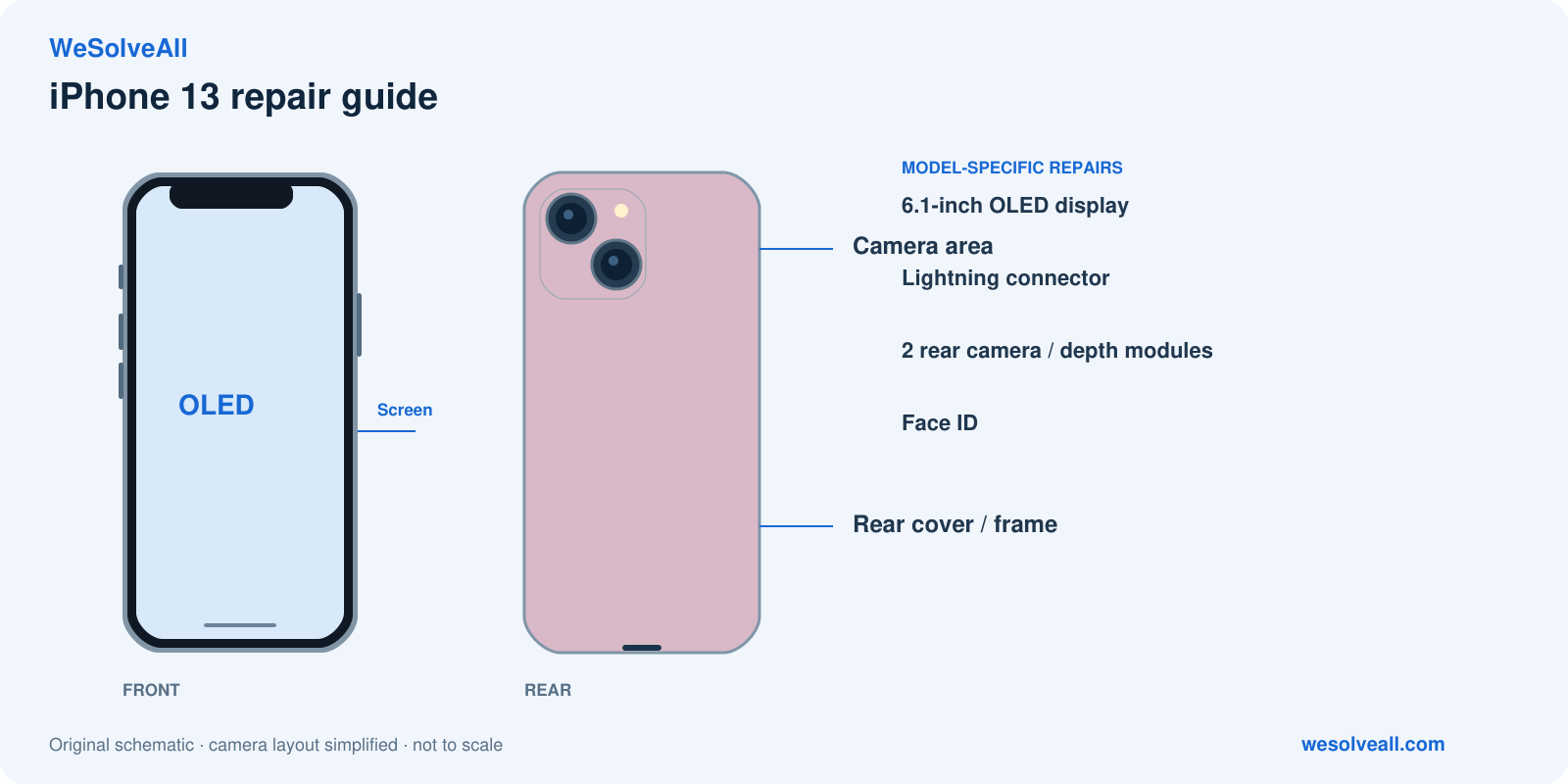
Which replacement screen should you choose?
The standard iPhone 13 uses a 6.1-inch OLED screen. When a shop offers genuine, refurbished or aftermarket options, ask whether each is OLED and what condition it's in. An LCD conversion may cost less, but it changes the type of display the phone came with.
These are the part descriptions you may come across. The shop needs to confirm what it can supply for your exact phone; every option won't be available from every repairer.
| Screen option | What you are paying for |
|---|---|
| New genuine Apple OLED | A new manufacturer-origin screen, if the shop can source one. Ask it to identify the part, confirm that it is new and include fitting, testing and any required repair-completion work in the price. |
| Used original OLED | An original screen taken from another handset. It is still a used part, so ask about scratches, wear, testing and its suitability for reuse on your phone. |
| Refurbished original OLED | An original panel with specified damaged parts renewed, often the outer glass. Ask what remains original, what has been replaced and who guarantees the finished screen. It isn't the same as a completely new manufacturer-supplied assembly. |
| Aftermarket soft OLED | A compatible OLED made by another manufacturer, using a flexible panel base. Ask for the actual part specification: the word soft doesn't tell you its brightness, touch quality or which original display features it preserves. |
| Aftermarket hard OLED | A compatible OLED using a rigid panel base, where a tested option exists for this model. Check its fit, display behaviour and warranty. The shop should explain any differences you would notice in use. |
| Budget LCD / in-cell conversion | An LCD alternative, only if the repairer has a tested option for this exact model. It changes the original OLED technology. Ask about picture quality, fit, power use and any lost display features before choosing it. |
| Glass-only refurbishment | A specialist replaces the broken outer glass while keeping a suitable working panel. The picture, touch layers and frame need checking first. It won't cure damage inside the display. |
When a cracked screen starts tapping by itself
A crack can be cosmetic at first and then become a touch problem. Missed letters, unexpected taps or parts of the keyboard that no longer respond are useful symptoms to describe. Avoid repeatedly entering a passcode if the damaged display is registering the wrong taps.
Glass refurbishment is only an option when the panel and touch layers are suitable to keep. A repairer needs to check that, along with the frame and connectors, before telling you which screen repair makes sense.
A shaking camera isn't always broken lens glass
The iPhone 13's rear cameras sit diagonally. A chip in the external cover and a camera that struggles to focus are different faults, even if they appeared after the same drop. Tell the shop whether the picture shakes, stays blurry or goes black, and whether the wider view still works.
That gives it somewhere useful to start. You shouldn't have to book a complete camera replacement just because you can see damage near the cameras.
What should feel different after a battery repair?
A worn battery can shorten the time between charges, but fitting a new one won't automatically cure a damaged Lightning port or a software problem. Explain how the fault developed: gradual loss of runtime is different from a phone that suddenly began restarting.
Ask what battery information and parts messages you should expect after the work. At collection, try the charging lead, cameras, sound and Face ID as well as checking the part that was repaired.
What else can be repaired on your iPhone 13?
You don't need to know the name of a faulty part before contacting a shop. The list below covers the repair and diagnostic areas for this model. Open a section to find the problem you recognise. Some parts share an assembly, so several symptoms may lead to one repair rather than several separate charges.
Screen and touch
- Display assembly
- Cracks, dark patches, lines or touch problems can call for a replacement screen assembly. The shop should check the display, frame and connections, then explain which of the screen choices above suits the damage.
- Front glass refurbishment
- If the picture and touch still work, a specialist may be able to keep the original panel and replace its outer glass. The display and frame have to be suitable; cracks alone don't settle that decision.
- Display connectors and circuit
- A connection or circuit fault can cause a missing image or unreliable touch. The repairer may need to repair the connector or original board. This OLED phone doesn't have a separate LCD-style backlight.
Battery and charging
- Battery and battery connector
- Shorter runtime, unexpected shutdowns or swelling are reasons to have the battery checked. If it needs replacing, ask whether the new battery is genuine or compatible, its stated capacity and warranty, and what battery information the phone should show afterwards. Stop charging a swollen phone.
- Lightning charging socket
- A loose lead, repeated disconnections or a damaged socket needs the cable and Lightning port checked. Careful professional cleaning may be enough when debris is the cause; damaged hardware needs a different repair.
- Wired charging and USB data diagnosis
- Tell the shop if charging is slow, the connection drops or a computer no longer recognises the phone. Testing a compatible lead and charger helps separate an accessory problem from socket or circuit damage.
- Wireless charging assembly
- If wireless charging fails while cable charging works, mention that. The shop can check a suitable charger and case first, then the coil, connections and charging circuit. A broken back may need checking at the same time.
Cameras and Face ID
- 12MP main camera
- A camera that shakes, won't focus or shows a black picture needs testing in the affected view. The shop can check the module and its connections, then name the actual camera or combined assembly in the quote.
- 12MP ultra-wide camera
- A camera that shakes, won't focus or shows a black picture needs testing in the affected view. The shop can check the module and its connections, then name the actual camera or combined assembly in the quote.
- External camera lens cover / surround
- Broken protective glass and a faulty camera are different repairs. The shop can inspect the lens cover, surround and camera beneath it before deciding whether new cover glass is enough.
- Front / selfie camera
- A blurry, black or unreliable selfie image needs the front camera and its connection checked. On this iPhone, the shop should also explain any implications for the adjacent Face ID system.
- Face ID
- If Face ID has stopped recognising you, ask for the original TrueDepth parts and connections to be checked. Some faults need specialist work. A generic camera swap isn't a guaranteed way to restore it.
- Flash and rear recording audio
- A failed torch, flash or poor audio while filming can involve different parts. Tell the shop exactly which functions fail so it can check settings, temperature restrictions, the microphone and the relevant connections.
Sound, calls and microphones
- Top / earpiece speaker
- Quiet or distorted sound at your ear can come from a blocked grille, speaker or connection fault. The shop can clean or replace the affected part, taking care around any adjoining front sensors.
- Bottom loudspeaker
- Missing or distorted ringtones, music or speakerphone audio can involve the bottom speaker. Its outlet and connections need checking before a replacement is chosen; persistent faults may need audio-circuit work.
- Microphones and audio paths
- Tell the repairer whether people can't hear you on calls, voice recordings sound poor or video audio is affected. Different modes can use different microphones, so the openings, relevant assembly and audio connections need testing.
Buttons, vibration and sensors
- Side / power and volume buttons
- Sticking controls, a missing click or an unreliable response can involve the external button, its mechanism or an internal cable. Describe which control fails and let the shop check settings and damage before selecting a part.
- Ring/silent switch
- Sticking controls, a missing click or an unreliable response can involve the external button, its mechanism or an internal cable. Describe which control fails and let the shop check settings and damage before selecting a part.
- Taptic Engine
- If vibration has become weak, noisy or stopped altogether, check the settings first. The repairer can then check the vibration unit and its connection and replace the correct part if needed.
- Proximity and ambient light sensing
- A screen that stays on against your cheek or brightness that changes oddly can involve the front sensors or their path through the screen. Mention if the problem began after screen work so fit and connections can be checked.
Signal, SIM and other connections
- SIM tray and physical reader, where fitted
- A damaged tray, stuck card or SIM detection problem needs the SIM and regional hardware checked. Some imported versions use different arrangements; an eSIM-only phone has no physical tray to replace.
- Mobile antennas and signal connections
- Poor reception needs coverage, account and SIM problems ruled out first. If hardware is responsible, the shop can check antennas and connectors, with specialist modem or board work where necessary.
- Wi-Fi, Bluetooth, GPS and NFC
- Explain which connections fail and whether the problem happens with more than one network or accessory. Software and settings checks come first, followed by the relevant antennas, connectors or board circuitry if needed.
- Other fitted sensors
- Location, contactless, motion or other sensor problems need their own checks. The shop can separate settings and software issues from damaged antennas or circuitry. These functions aren't all separate plug-in parts.
Back glass, frame and seals
- Back cover / back glass
- Cracked rear glass needs checking for damage underneath. Ask whether the quote covers glass or a complete rear assembly, and have the frame, camera area and wireless charging checked where relevant.
- Frame / enclosure
- Bent corners, gaps and parts that no longer sit correctly can need a replacement housing or frame. Ask which model, colour and assembly the quote covers, and which working parts will be transferred.
- Adhesives, seals and thermal materials
- Opening the phone usually means renewing the adhesives and other materials required by the repair. Ask how it will be resealed and tested. Fresh seals alone don't guarantee the original factory water-resistance rating.
Internal connections and specialist work
- Cables, brackets, shields and fixings
- A damaged cable, connector, bracket or mounting can stop an otherwise working part doing its job. The repairer should identify the broken connection or fixing and quote for that work.
- Motherboard / logic board
- A confirmed circuit fault may need specialist work on the original board or a properly specified replacement. Ask about the difference in price, pairing and data consequences before choosing; another board won't bring back the files on the original one.
- Liquid damage assessment
- Tell the shop what happened and whether the phone was charged afterwards. Inspection and suitable cleaning can establish which parts are affected, but recovery and long-term reliability depend on the damage. Stop charging a wet phone.
- No power, restarting and overheating
- A phone that won't start, keeps restarting or shuts down needs the cause checked. Battery, software, internal connections and board faults can produce similar symptoms, so booking a guessed replacement part can waste money.
Software, backup and data
- Software, backup and data recovery
- Say whether you want normal operation restored, files recovered or help with a backup or transfer. Agree before any reset that could erase data. Recovery depends on the original hardware, damage, encryption and access credentials.
Parts, price and the small print worth reading
For a battery, ask whether the replacement is new genuine or a traceable compatible part, with its capacity and warranty stated. Reusing an original battery control board doesn't make a compatible replacement cell wholly genuine. Cameras, charging assemblies and cosmetic parts need the same clear description of origin, condition and compatibility.
Get the total fitted price, including VAT where applicable, any diagnostic charge and the likely collection time. Agree how the shop will contact you if it finds more damage. If your photos or documents are the priority, say so before a reset or board replacement is discussed.
iPhone 13 repair questions
Can the glass be replaced without changing the whole iPhone 13 screen?
Sometimes. The OLED panel, touch layer and frame must be in suitable condition. Lines, black patches or unreliable touch may mean the assembly needs replacing.
Will a new battery fix repeated restarts?
Only if the battery is the cause. Restarts can also come from software, connections or other hardware, so describe the fault before choosing the repair.
How much will the repair cost?
The shop needs to know the fault, exact model and proposed part. Ask for the total fitted price and compare the part description, testing and warranty alongside it. Prices and appointment availability come from the selected repairer.
Will the phone be water-resistant afterwards?
Ask how the shop will replace seals and what it can test. Fresh adhesive doesn't, by itself, guarantee the original factory water-resistance rating. Keep a phone with broken glass or openings away from water.
What should I check when I collect it?
Try the repaired function and anything affected by the work: touch, cameras, charging, call sound and the phone's supported unlocking method. Ask the repairer to explain any parts message or feature limitation before you leave.
Find an iPhone 13 repair shop
If you're unsure whether to repair your iPhone 13, get the fault checked and ask for the total fitted price. WeSolveAll helps you find independent repair shops so you can discuss the part, warranty and collection time before making a decision.
Find a repair shop