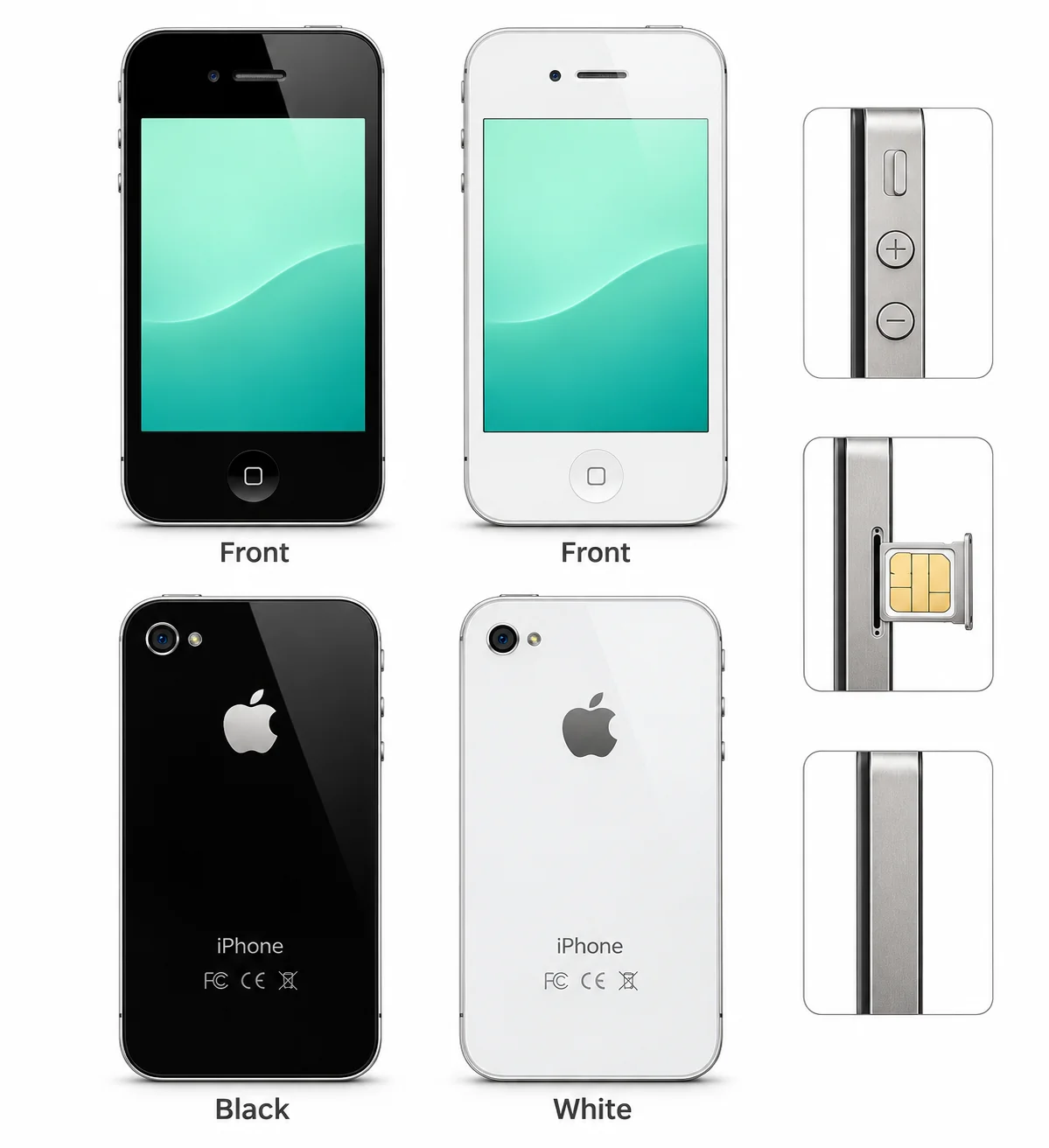
iPhone 4 model numbers
A model number identifies the model or hardware version and is shared by many devices. Your serial number identifies your individual device, as does the IMEI.
Where to find your model number
- Open Settings, then General, then About.
- Where available, tap the value beside Model Number to switch from the part number to the A-number.
- Match the A-number to this model's list. On older software, use the rear marking if the A-number is not shown in Settings.
If the phone will not turn on: Look for the A-number printed on the back of the handset.
All 2 A-number variants in Apple's current identification entry for iPhone 4. Regional labels are included where Apple specifies them; an unspecified regional allocation is not a UK-only claim.
Swipe the table sideways on a narrow screen.
| Model number | Country or region | Useful detail |
|---|---|---|
| A1349 | CDMA variant | The GSM model has a micro-SIM tray; the CDMA model does not. |
| A1332 | GSM variant | The GSM model has a micro-SIM tray; the CDMA model does not. |
All 2 standard colours
These are the original manufacturer finishes listed for this model, including documented later colours. Availability varied over time and by market.
- Black
Approximate colour hint; the finish can look different with lighting, wear and replacement parts.
- White
Approximate colour hint; the finish can look different with lighting, wear and replacement parts.
Use the colour and the model number together. Lighting, screen settings, cases and replacement backs can change how a device looks.
Getting to know the iPhone 4
Where the iPhone 4 fits
The iPhone 4 is Apple's 2010 model with a 3.5-inch Retina display, A4 chip and flat glass panels. A stainless steel band runs around its edges. Black and White versions were released, and the square-marked Home button predates Touch ID.
Screen, cameras and everyday controls
A 5MP rear camera records 720p video and has an LED flash. The front camera captures VGA images and video. Its Retina screen has 960 × 640 pixels, a higher pixel count than the 480 × 320 display on the curved plastic-backed 3GS.
Checking the exact handset
Apple lists 8GB, 16GB and 32GB capacities and both GSM and CDMA hardware variants. The CDMA version has no SIM tray; the GSM version uses micro-SIM. Charging uses the wide 30-pin connector. Check the A-number because the nearly identical 4s is a separate model.
Specifications and what they mean
Read each specification alongside its explanation. Manufacturer test figures describe controlled conditions; age, usage and battery condition affect everyday performance.
Swipe the table sideways on a narrow screen.
| Feature | iPhone 4 | What it means |
|---|---|---|
| Introduced | 2010 | The year Apple records for this distinct model. |
| Screen | 3.5-inch LCD | The diagonal measures the display, not the overall phone body. Rounded corners can reduce the viewable area. |
| Resolution | 960 × 640 pixels; 326 ppi | Pixel dimensions describe the image grid; ppi is the number of pixels per inch. |
| Size and weight | 115.2 × 58.6 × 9.3 mm; 137 g | Height × width × depth before adding a case. Figures are from Apple’s UK specification. |
| Construction | Glass front and back with a stainless steel edge band | Materials and shape help identify the device; a case can hide these details. |
| Processor | A4 | The main Apple chip processes apps, graphics and camera tasks. |
| Storage | 8GB, 16GB, 32GB | All capacities recorded in Apple’s complete identification range; usable space is lower and availability varied over time. |
| Rear cameras | 5MP camera | Different lenses give different fields of view. A zoom setting does not necessarily represent an additional lens. |
| Front camera | VGA front camera | Used for selfies or video calls where fitted; TrueDepth also supports Face ID. |
| Wired connection | 30-pin dock connector | Use a cable that matches this connector when charging or connecting to a computer. |
| Wireless charging | Not listed as built-in | Use compatible charging equipment. A magnetic case does not change the phone’s built-in charging specification. |
| Mobile connection | 3G-era mobile radio; variant and network dependent | The network, plan, regional hardware and available local service determine connectivity. |
| SIM: UK specification | Micro-SIM on GSM variant; no tray on CDMA variant | Imported variants can differ. eSIM requires network support where listed. |
| Unlocking | Passcode; conventional Home button | The listed hardware distinguishes fingerprint, facial-recognition and older Home-button designs. |
Software and security updates
Checked on 20 November 2026: iPhone 4 is absent from Apple's current iOS 27 compatibility list. This check does not establish the last security patch for the handset. Confirm the installed software and the requirements of the apps and services you plan to use.
Common questions about the iPhone 4
Why do some iPhone 4 handsets have no SIM tray?
Apple released a CDMA iPhone 4 variant without a SIM tray. The GSM variant has a micro-SIM tray. A missing tray opening is therefore not enough to determine damage or authenticity; match the A-number and variant.
How do I identify my iPhone 4?
Apple lists A1349, A1332 for iPhone 4. Check Settings, General, About, then tap Model Number where supported to reveal the A-number. For an older phone, check the marking on the rear. Match the complete code, because finish and screen size are only supporting clues.
How does the iPhone 4 charge?
iPhone 4 uses 30-pin dock connector for wired charging. Apple does not list built-in wireless charging for this model. An accessory or adapter should be checked on its own specifications.
Is the iPhone 4 compatible with iOS 27?
Checked on 20 November 2026: iPhone 4 is absent from Apple's current iOS 27 compatibility list. This check does not establish the last security patch for the handset. Confirm the installed software and the requirements of the apps and services you plan to use.
About this guide
Manufacturer information checked 20 November 2026. Regional features, software availability and colours can vary. Pictures are visual guides; colours and small details are approximate.