iPhone SE (2nd generation) model numbers
A model number identifies the model or hardware version and is shared by many devices. Your serial number identifies your individual device, as does the IMEI.
Where to find your model number
- Open Settings, then General, then About.
- Where available, tap the value beside Model Number to switch from the part number to the A-number.
- Match the A-number to this model's list. On older software, use the rear marking if the A-number is not shown in Settings.
If the phone will not turn on: If the handset has a SIM tray, remove the tray and read the A-number inside the slot on the display side. If there is no SIM tray, look on the display side inside the charging connector; bright overhead light helps.
All 3 A-number variants in Apple's current identification entry for iPhone SE (2nd generation). Regional labels are included where Apple specifies them; an unspecified regional allocation is not a UK-only claim.
Swipe the table sideways on a narrow screen.
| Model number | Country or region | Useful detail |
|---|---|---|
| A2275 | Canada, United States | Match this code to the number on your phone. |
| A2298 | China mainland | Match this code to the number on your phone. |
| A2296 | UK, Ireland and other countries/regions outside the listed regional groups | Apple groups this code under 'other countries and regions'; the UK specification confirms this regional hardware family. |
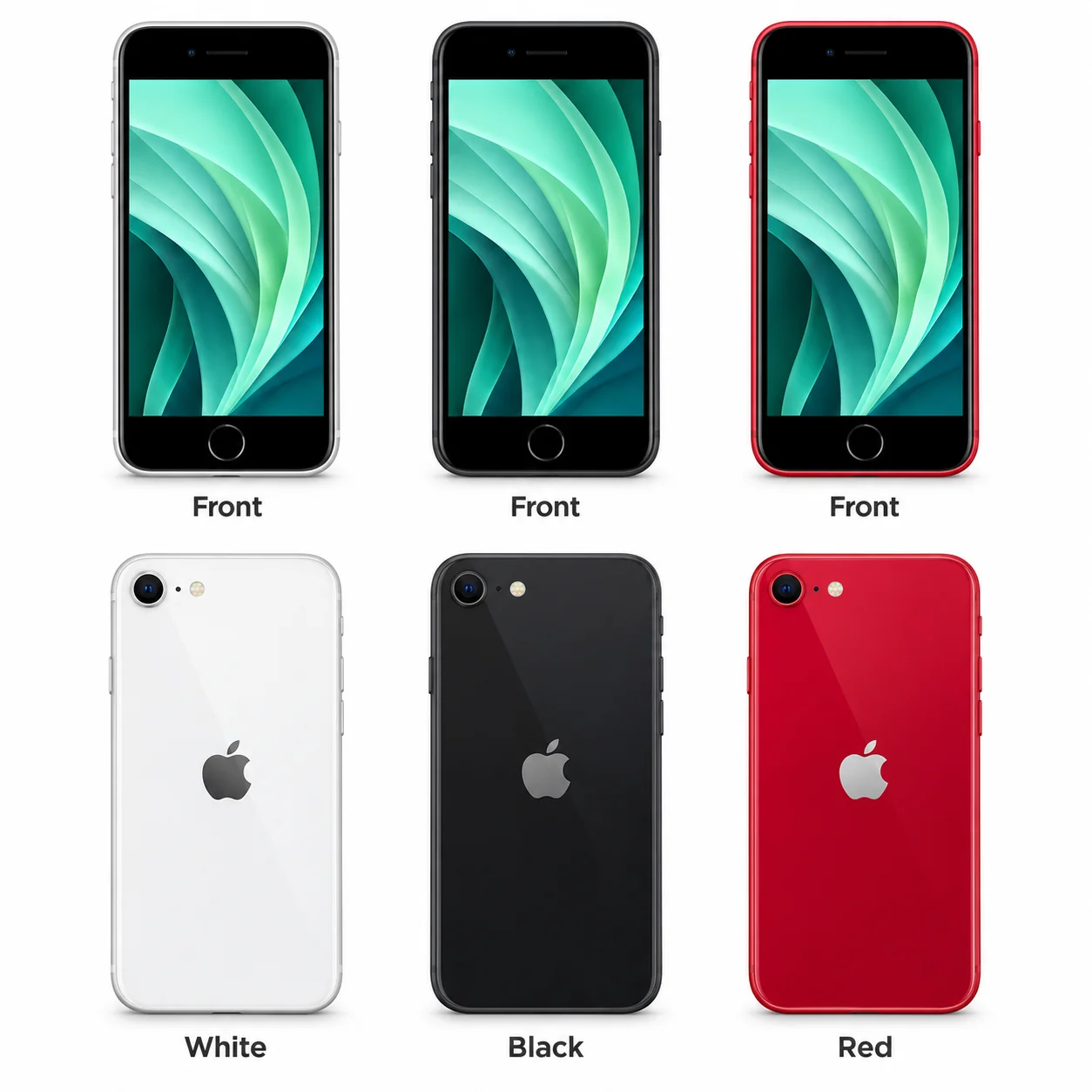
All 3 standard colours
These are the original manufacturer finishes listed for this model, including documented later colours. Availability varied over time and by market.
- White
Approximate colour hint; the finish can look different with lighting, wear and replacement parts.
- Black
Approximate colour hint; the finish can look different with lighting, wear and replacement parts.
- Red
Approximate colour hint; the finish can look different with lighting, wear and replacement parts.
Use the colour and the model number together. Lighting, screen settings, cases and replacement backs can change how a device looks.
Getting to know the iPhone SE (2nd generation)
Where the iPhone SE (2nd generation) fits
The second-generation iPhone SE is the 2020 SE, with a 4.7-inch LCD, A13 Bionic chip and Touch ID Home button. Its Black, White and Red finishes surround a glass-backed body. This is a separate model from both the smaller 2016 SE and the 5G-equipped 2022 SE.
Screen, cameras and everyday controls
A single 12MP Wide camera captures rear photographs and video, with a 7MP front camera for selfies and calls. The fingerprint reader is in the Home button, so there is no Face ID or display notch. Its mobile radio specification is 4G LTE rather than 5G.
Checking the exact handset
The phone uses Lightning for wired charging and supports Qi wireless charging. Capacity choices are 64GB, 128GB and 256GB. Use the generation or A-number in any repair enquiry: the generic name 'iPhone SE' does not identify which body and internal hardware are involved.
Specifications and what they mean
Read each specification alongside its explanation. Manufacturer test figures describe controlled conditions; age, usage and battery condition affect everyday performance.
Swipe the table sideways on a narrow screen.
| Feature | iPhone SE (2nd generation) | What it means |
|---|---|---|
| Introduced | 2020 | The year Apple records for this distinct model. |
| Screen | 4.7-inch LCD | The diagonal measures the display, not the overall phone body. Rounded corners can reduce the viewable area. |
| Resolution | 1334 × 750 pixels; 326 ppi | Pixel dimensions describe the image grid; ppi is the number of pixels per inch. |
| Size and weight | 138.4 × 67.3 × 7.3 mm; 148 g | Height × width × depth before adding a case. Figures are from Apple’s UK specification. |
| Construction | Aluminium frame and glass back | Materials and shape help identify the device; a case can hide these details. |
| Processor | A13 Bionic | The main Apple chip processes apps, graphics and camera tasks. |
| Storage | 64GB, 128GB, 256GB | All capacities recorded in Apple’s complete identification range; usable space is lower and availability varied over time. |
| Rear cameras | 12MP Wide camera | Different lenses give different fields of view. A zoom setting does not necessarily represent an additional lens. |
| Front camera | 7MP front camera | Used for selfies or video calls where fitted; TrueDepth also supports Face ID. |
| Wired connection | Lightning | Use a cable that matches this connector when charging or connecting to a computer. |
| Wireless charging | Qi | Use compatible charging equipment. A magnetic case does not change the phone’s built-in charging specification. |
| Mobile connection | 4G LTE; bands vary by A-number | The network, plan, regional hardware and available local service determine connectivity. |
| SIM: UK specification | Nano-SIM and eSIM | Imported variants can differ. eSIM requires network support where listed. |
| Unlocking | Touch ID in Home button | The listed hardware distinguishes fingerprint, facial-recognition and older Home-button designs. |
| Software compatibility | Listed for iOS 27 | Compatibility checked on 20 November 2026; individual features and later updates must be checked separately. |
Software and security updates
Apple lists iPhone SE (2nd generation) as compatible with iOS 27, checked on 20 November 2026. Features vary by model and region. Open Settings, General, then Software Update to see the versions offered to your handset.
Common questions about the iPhone SE (2nd generation)
Does the 2020 iPhone SE support 5G?
No. Apple lists 4G LTE for the second-generation SE. The third-generation SE from 2022 adds 5G, despite having a very similar 4.7-inch Home-button design.
How do I identify my iPhone SE (2nd generation)?
Apple lists A2275, A2298, A2296 for iPhone SE (2nd generation). Check Settings, General, About, then tap Model Number where supported to reveal the A-number. For an older phone, check the marking on the rear. Match the complete code, because finish and screen size are only supporting clues.
How does the iPhone SE (2nd generation) charge?
iPhone SE (2nd generation) uses Lightning for wired charging. Apple also lists Qi wireless charging. Use compatible equipment and check the handset's charging port for visible damage if it charges unreliably.
Is the iPhone SE (2nd generation) compatible with iOS 27?
Apple lists iPhone SE (2nd generation) as compatible with iOS 27, checked on 20 November 2026. Features vary by model and region. Open Settings, General, then Software Update to see the versions offered to your handset.
About this guide
Manufacturer information checked 20 November 2026. Regional features, software availability and colours can vary. Pictures are visual guides; colours and small details are approximate.